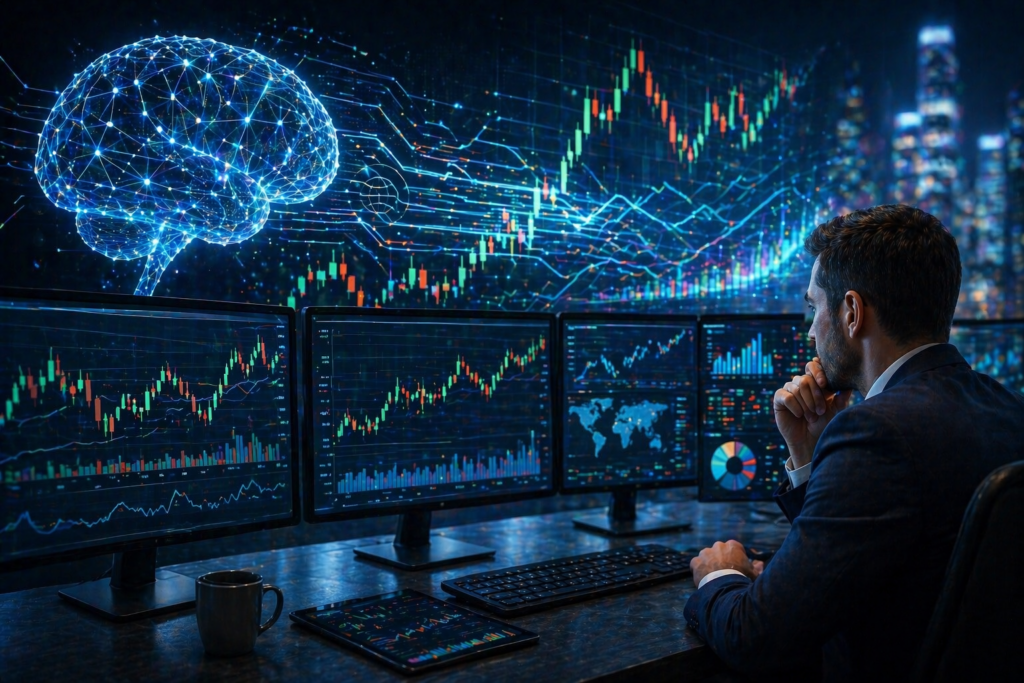
In recent years, artificial intelligence has become one of the most important tools in financial markets. Its use in trading has fundamentally changed the way data is analyzed and decisions are made. Modern algorithms are capable of processing enormous amounts of data in fractions of a second and recognizing patterns that previously remained hidden. This enables traders to act faster, more precisely, and more efficiently, adapting better to constantly changing market conditions.
Analysis of Large Data Volumes
Artificial intelligence can analyze vast amounts of data, including historical prices, trading volume, macroeconomic indicators, and news.
This comprehensive analysis makes it possible to identify complex correlations and hidden patterns that would be nearly impossible to find manually.
This gives traders a deeper understanding of the market situation and enables more informed decisions.
Detection of Trading Signals
One of AI’s core functions is identifying trading signals. Algorithms recognize patterns and deviations in the data that may indicate potential market movements.
These signals are generated in real time, allowing traders to react quickly.
This increases the probability of successful trades and reduces the influence of random market movements.
Automation of Decisions
AI enables the automation of trading decisions. Systems can independently open and close positions based on predefined strategies and algorithms.
This significantly shortens reaction time.
At the same time, automation ensures more discipline in trading and reduces impulsive decisions.
Reducing Emotional Influences
Emotions such as fear or greed are common causes of misjudgments in trading.
Artificial intelligence, on the other hand, works purely data-based and objectively.
This minimizes subjective influences and leads to more consistent and rational decisions.
Accelerating Information Processing
A key advantage of AI is the speed of information processing. Systems can analyze data and make decisions in milliseconds.
This is particularly important in volatile markets where every second counts.
The rapid response enables traders to effectively seize short-term opportunities and stay one step ahead of the market.
Conclusion: Artificial intelligence is developing into an indispensable component of modern trading. Through the analysis of large data volumes, automation of processes, signal identification, and reduction of emotional influences, trading is becoming faster and more precise. In an increasingly competitive environment, AI offers a decisive advantage by enabling faster reactions and more informed decisions.