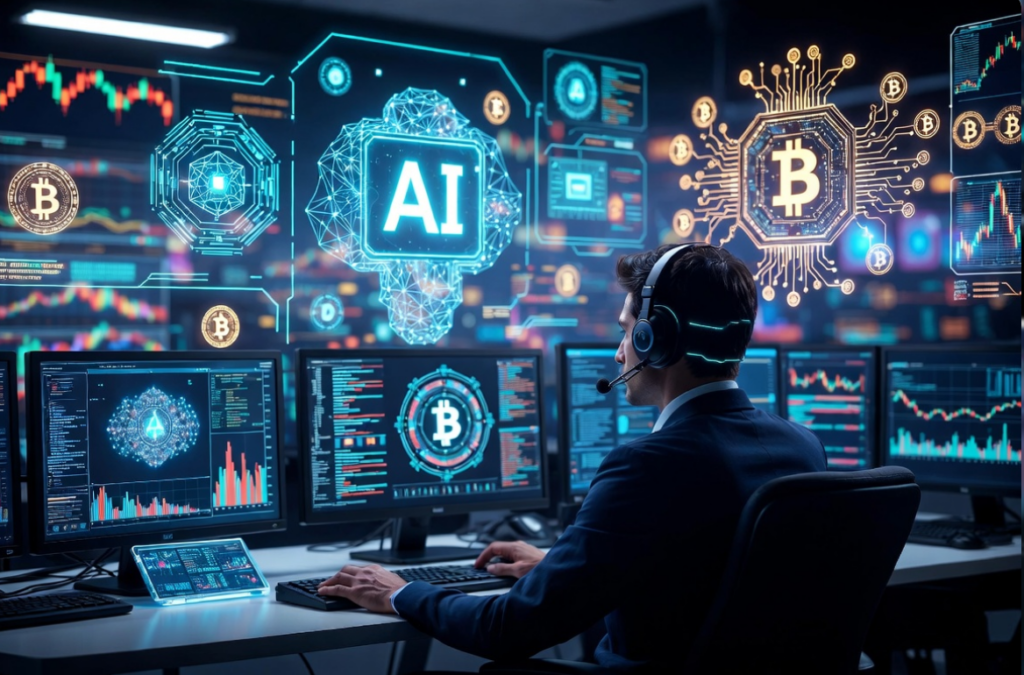
Artificial intelligence (AI) has become one of the most significant technologies fundamentally reshaping the financial world. In 2026, AI is no longer an experimental novelty but an everyday tool for millions of traders, investors, and financial institutions. It helps analyze vast amounts of data, make more informed decisions, and automate routine processes.
Big Data Analysis
Traditional market analysis relied on a limited number of indicators and human experience. AI can process petabytes of data in seconds: news, corporate reports, social media posts, satellite images, geodata, transactions, and even market sentiment.
Machine learning algorithms detect hidden patterns that a human simply cannot notice. For instance, AI can simultaneously analyze 10,000 stocks and find correlations between seemingly unrelated events.
Trade Automation
AI-based algorithmic trading (algo-trading) now dominates the markets. High-speed trading robots (HFT) execute thousands of transactions per second and react to price changes faster than any human.
Modern AI systems not only handle execution but make decisions independently:
- Which assets to select
- Optimal volume and timing for entry and exit
- Risk management in real time
- Adaptation to changing market conditions
Market Forecasts
AI has significantly improved the quality of predictions. Neural networks, particularly transformer models and Large Language Models (LLMs), analyze unstructured data and deliver probability-based forecasts with high accuracy.
Many hedge funds and prop trading firms now use AI models that take into account:
- Macroeconomic indicators
- Geopolitical risks
- Investor sentiment on social networks
- Climatic and seasonal factors
Reducing the Human Factor
One of the biggest human drawbacks in trading is emotions: fear, greed, fatigue, and cognitive biases. AI is completely free of these factors. It acts strictly according to set parameters and statistical probability.
This is especially important when managing large portfolios and in long-term investments, where emotional decisions often lead to significant losses.
Increased Efficiency and Accessibility
AI makes professional tools accessible to retail investors as well. Apps with AI assistants already offer:
- Personalized investment recommendations
- Automatic portfolio rebalancing
- Real-time risk management
- Strategy learning and simulation features
As a result, even beginners can now use technologies that were once available only to large funds.
Conclusion
Artificial intelligence is transforming trading, making it faster, more technological, and more rational. What sounded like science fiction just ten years ago is now standard practice.
It is important to understand, however: AI is a powerful tool, not a magic wand. It does not replace the necessary knowledge, discipline, and understanding of risks. The best results are achieved by traders and investors who skillfully combine the capabilities of AI with their own experience and strategic thinking.
In the coming years, the role of AI in financial markets will continue to grow sharply. Those who learn to use it effectively will gain a substantial competitive advantage in the global market.