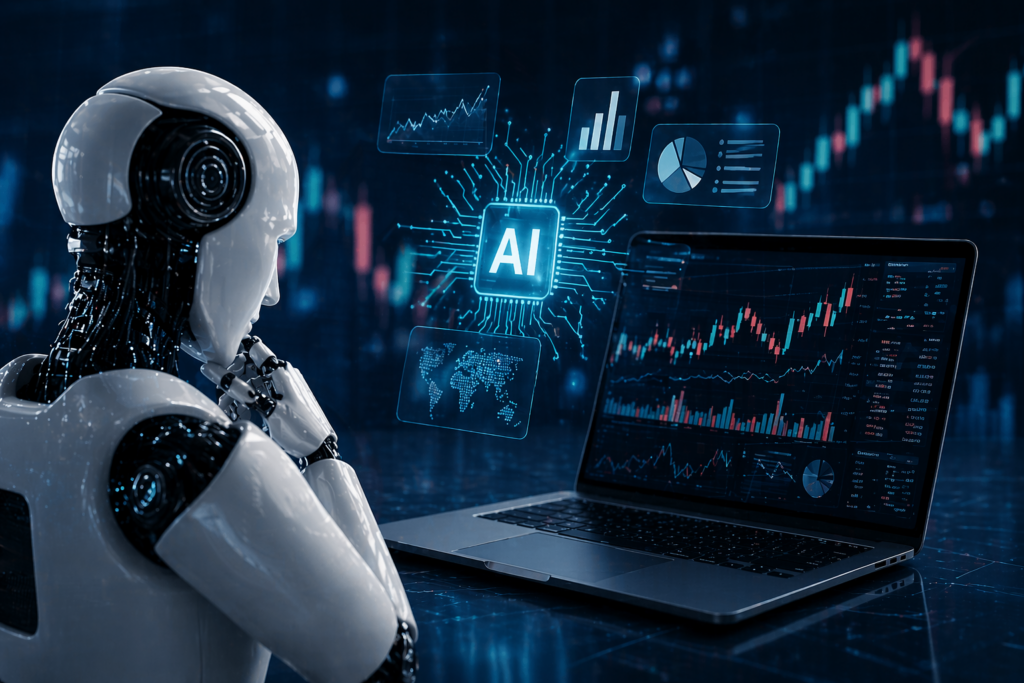
In 2026, artificial intelligence has become an integral part of financial markets, fundamentally changing the approach to trading and investing. Technologies such as machine learning and big data analysis make it possible to process enormous amounts of data in fractions of a second and recognize patterns that are barely visible to humans. As a result, strategies are changing, decision-making processes are being accelerated, and the competitive structure of the markets is shifting. Trading is becoming increasingly technology-based, while the human role is shifting toward monitoring and fine-tuning the systems.
Algorithmic Analysis
Algorithmic analysis forms the foundation of modern trading strategies. Artificial intelligence processes not only classic market data such as prices and volume but also alternative information sources like news, social media, and macroeconomic indicators.
In 2026, such systems are capable of recognizing complex relationships and hidden patterns that would be barely detectable manually. This enables more precise and more informed decisions.
Furthermore, algorithms continuously learn and adapt to changing market conditions, further increasing efficiency and accuracy.
Automation of Trading
Automation is one of the greatest advantages of using AI in trading. Modern systems can independently open and close positions, manage portfolios, and react to market changes.
This significantly increases execution speed, which is especially crucial in volatile markets.
Additionally, automation eliminates emotional decisions that often lead to errors. This makes trading more structured, disciplined, and overall more efficient.
Market Forecasts
Artificial intelligence has significantly improved the possibilities of market forecasting. Using complex models and neural networks, historical data can be analyzed and probabilities for future developments calculated.
This allows traders to better assess risks and opportunities.
Even though forecasts are never completely exact, they provide a considerable advantage in strategic decisions and increase orientation in uncertain market phases.
Reducing the Human Factor
A key effect of AI is the reduction of the influence of human emotions. Factors such as fear or greed often lead to irrational decisions.
AI, on the other hand, works data-based and objectively, thereby reducing subjective errors.
Nevertheless, the human element remains important, as it monitors the systems, steers them, and sets strategic frameworks.
Increasing Competition
The use of artificial intelligence has significantly intensified competition in financial markets. Market participants with advanced technology have clear advantages over less well-equipped players.
This leads to faster development of new technologies and strategies.
At the same time, market access becomes more demanding, as technological know-how plays an increasingly larger role.
Conclusion: Artificial intelligence has become a central component of trading in 2026. Algorithmic analysis, automation, improved forecasts, and the reduction of human errors make trading more efficient and precise. At the same time, competitive pressure is increasing, further driving innovation forward. In the modern financial world, AI is no longer just a tool but a fundamental prerequisite for successful trading strategies.