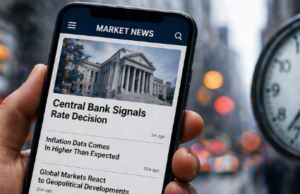

In the modern financial world, the decisions of the US Federal Reserve have become one of the most important factors determining the direction of global markets. Changes in interest rates, comments from central bank officials, and even hints about future measures can instantly affect the prices of assets worldwide. Today, markets increasingly move not because of actual actions but because of expectations. This is particularly visible during times of high uncertainty, when investors use the Fed’s signals as a central reference point. As a result, markets become more sensitive, faster, and more strongly interconnected.
Interest Rate Expectations
One of the Fed’s most important influencing factors is expectations regarding interest rates. Interest rates determine the cost of credit, the availability of liquidity, and the attractiveness of various asset classes. Traders carefully analyze economic data to predict future decisions.
Even small changes in expectations can trigger significant market movements. When investors price in rate hikes, this can put pressure on risky assets.
Conversely, expectations of looser monetary policy often support rising markets. Thus, expectations become the central driver of market movements even before actual decisions are made.
Reaction of Bitcoin and the Crypto Market
The crypto market, including Bitcoin, increasingly reacts sensitively to the Fed’s monetary policy. Despite its decentralized nature, the crypto market is closely linked to global liquidity.
When the Fed tightens its policy, liquidity decreases, putting pressure on crypto assets. During such phases, Bitcoin often shows declines or increased volatility.
In contrast, the expectation of looser monetary policy can promote capital inflows into the crypto market. This makes it clear that cryptocurrencies are increasingly part of the global financial system, where the Fed’s decisions play an important role.
Impact on Forex and Stock Markets
The Fed’s decisions have significant effects on the foreign exchange and stock markets. In the forex market, interest rate expectations are directly reflected in the value of the US dollar and affect all currency pairs.
A stronger dollar often leads to falling commodity prices and burdens emerging markets.
In stock markets, rising interest rates can reduce the attractiveness of equities, while loose monetary policy supports growth. Thus, the Fed’s policy becomes a central factor for all asset classes.
Increasing Volatility Before Announcements
Volatility in the markets often increases before Fed meetings. Investors take a wait-and-see stance while uncertainty simultaneously rises.
Rumors, forecasts, and comments can trigger strong price movements even before official decisions.
After the release of the decisions, volatility often continues to increase, as markets react quickly to new information. This creates opportunities but also increases risks for traders.
Behavior of Institutional Investors
Large institutional investors follow the Fed’s policy particularly closely, as it directly influences their strategies. They intensively analyze central bank signals and often position themselves in advance.
This amplifies market movements, as large capital flows can significantly influence prices.
Moreover, institutional players often set the direction for the overall market by shaping trends and amplifying the reaction to Fed decisions.
Conclusion: In today’s financial world, markets are increasingly driven by expectations of the Federal Reserve’s decisions. Interest rates, communication, and signals from the central bank shape investor behavior and determine the direction of assets. Bitcoin, forex, and stock markets increasingly react in sync, reflecting the importance of global liquidity. This makes markets more sensitive and more strongly interconnected. Understanding the Fed’s role helps investors better orient themselves, manage risks, and effectively seize opportunities.