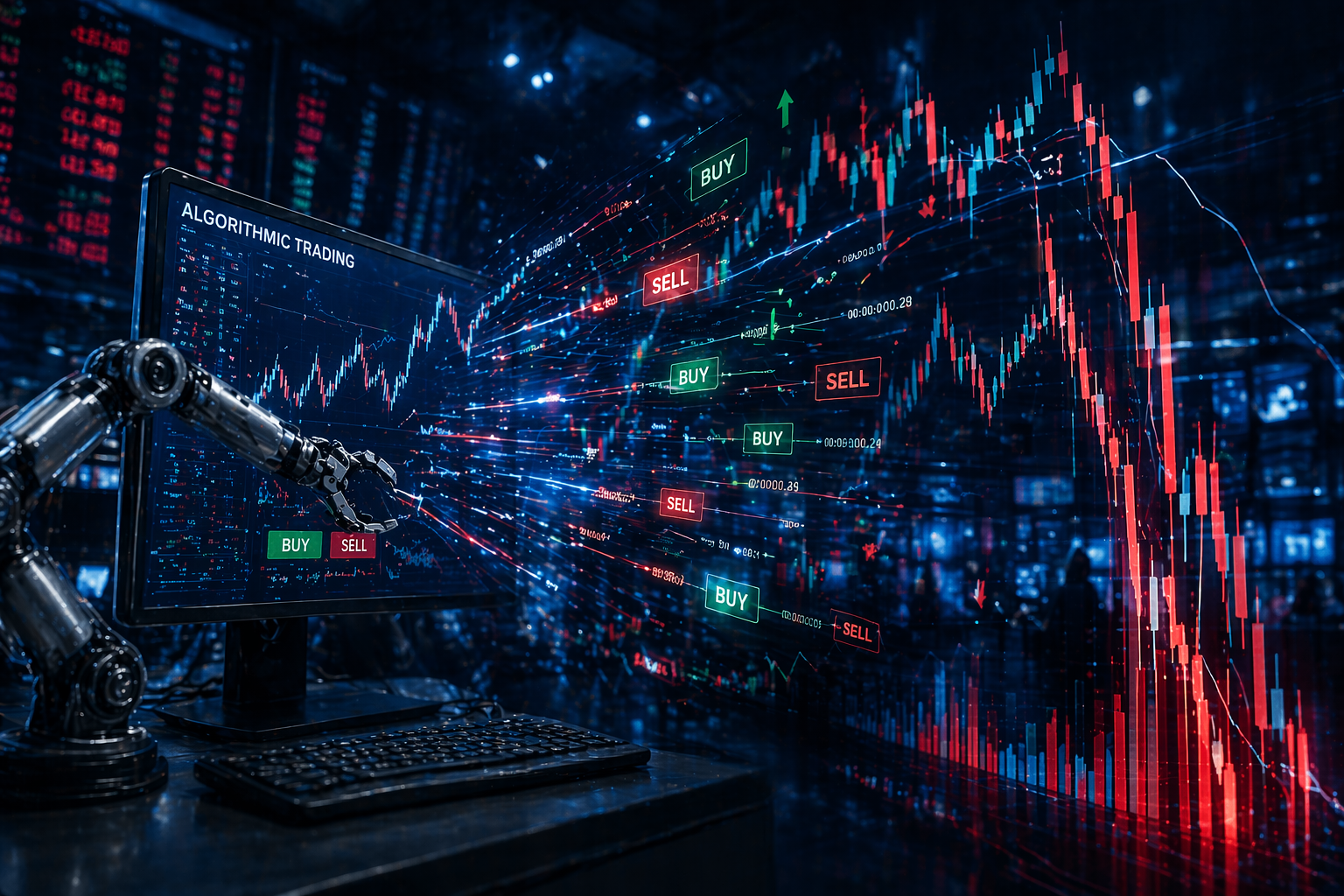
Modern financial markets are increasingly characterized by algorithmic trading, which has fundamentally changed the speed and dynamics of price movements. Automated systems can analyze data and execute transactions within milliseconds, making markets significantly more responsive. At the same time, however, volatility also increases, as many algorithms react to similar signals. Even small events can thereby trigger strong market movements, reducing stability and making predictability more difficult.
High-Frequency Trading
High-frequency trading (HFT) is a central component of algorithmic trading. It is based on powerful computer systems capable of executing thousands of transactions per second. These strategies aim to exploit minimal price differences.
At the same time, the extreme speed means that market movements can be amplified when many systems are simultaneously active.
As a result, markets react more sensitively to short-term signals and show more intense as well as less predictable price movements.
Fast Transactions
Algorithmic systems enable transactions in near real-time. Changes in the market are recognized and implemented immediately.
This speed shortens periods of stability and significantly accelerates price movements.
The high number of fast transactions increases market liquidity but can also lead to increased instability, as even the smallest impulses are immediately amplified.
Reaction to News
Algorithms continuously analyze news, economic data, and even content from social media.
They react immediately to keywords and changes in the market environment.
As a result, markets often begin to react before human actors have fully processed the information. This leads to faster and frequently stronger market movements.
Amplification of Trends
Algorithmic trading can significantly amplify existing trends. Once a system detects a clear market direction, it often increases trading activity in that direction.
When many algorithms react similarly, an amplification effect is created.
This leads to stronger trends, which are, however, also more susceptible to sudden reversals once market conditions change.
Increasing Instability
The combination of speed, automation, and synchronous reactions leads to overall higher market instability.
Algorithms can accelerate and amplify both upward and downward movements.
This creates faster and stronger fluctuations, making the market more complex and riskier, especially for non-automated investors.
Conclusion: Algorithmic trading has fundamentally changed the structure of modern financial markets. High-frequency strategies, fast transactions, and automated reactions to information increase volatility and make markets more dynamic but also more unpredictable. Markets become faster and more aggressive, creating new opportunities while simultaneously increasing risks. An understanding of these mechanisms is crucial to successfully adapt to the new market conditions and effectively manage risks.