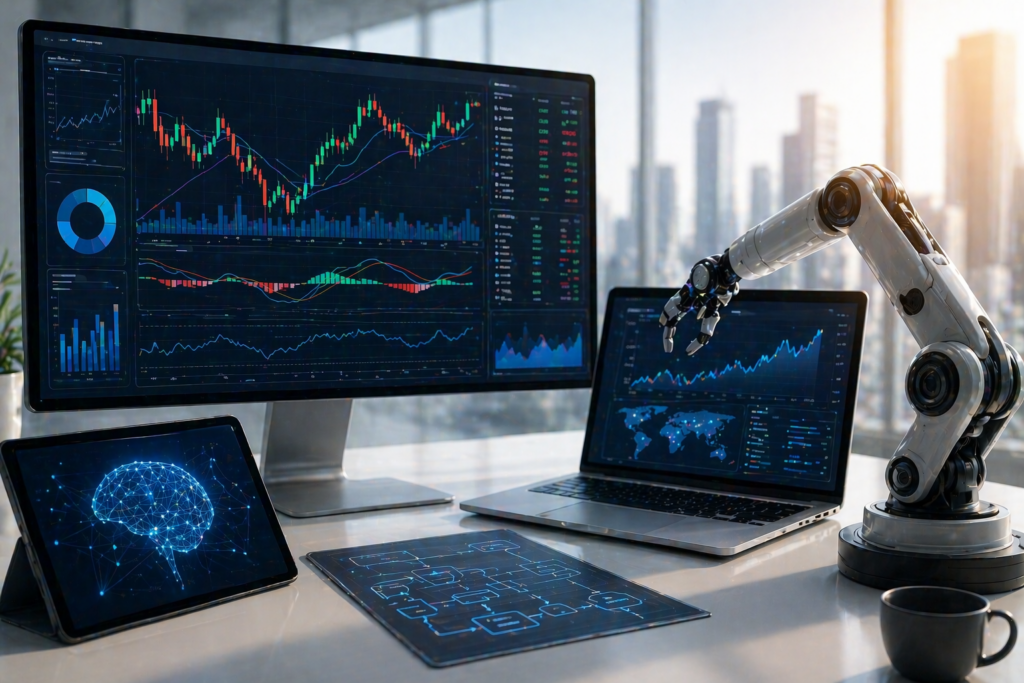
Modern financial markets are evolving rapidly, and trading approaches are changing along with them. Automation is no longer just an advantage — it is a necessity for traders aiming for stable results. The use of algorithms and trading systems makes it possible to significantly increase efficiency, minimize human errors, and adapt to the high speed of the markets. In an increasingly competitive environment, automation is becoming the new standard in trading.
Reducing Emotional Influences
One of the most important advantages of automation is the reduction of emotional decisions. Fear, greed, and uncertainty often lead to mistakes in trading.
Automated systems operate strictly according to fixed rules and avoid subjective influences.
This makes the trading process more disciplined and stable.
Fast Trade Execution
Automated systems can execute trades in milliseconds and react instantly to market changes.
This speed is hardly achievable for human traders.
Especially in volatile markets, a fast reaction can be decisive for success.
24/7 Operation
Automated trading solutions work around the clock without breaks.
This is particularly important for markets like cryptocurrencies, which are continuously active.
Traders can thus seize opportunities without constantly having to monitor the market.
Increased Accuracy
Algorithms trade based on clearly defined rules and data.
This reduces errors and ensures higher precision in trading decisions.
Adherence to strategies is consistently implemented.
Use of Modern Technologies
Technologies such as artificial intelligence, machine learning, and big data drive the development of automated systems forward.
They enable deeper analyses and faster adaptation to market changes.
This creates a clear competitive advantage for traders who use such technologies.
Conclusion: Trading automation is increasingly becoming the standard in modern trading. It improves speed, accuracy, and efficiency while reducing emotional influences. In the future, its significance will continue to grow and set new benchmarks for trading in financial markets.