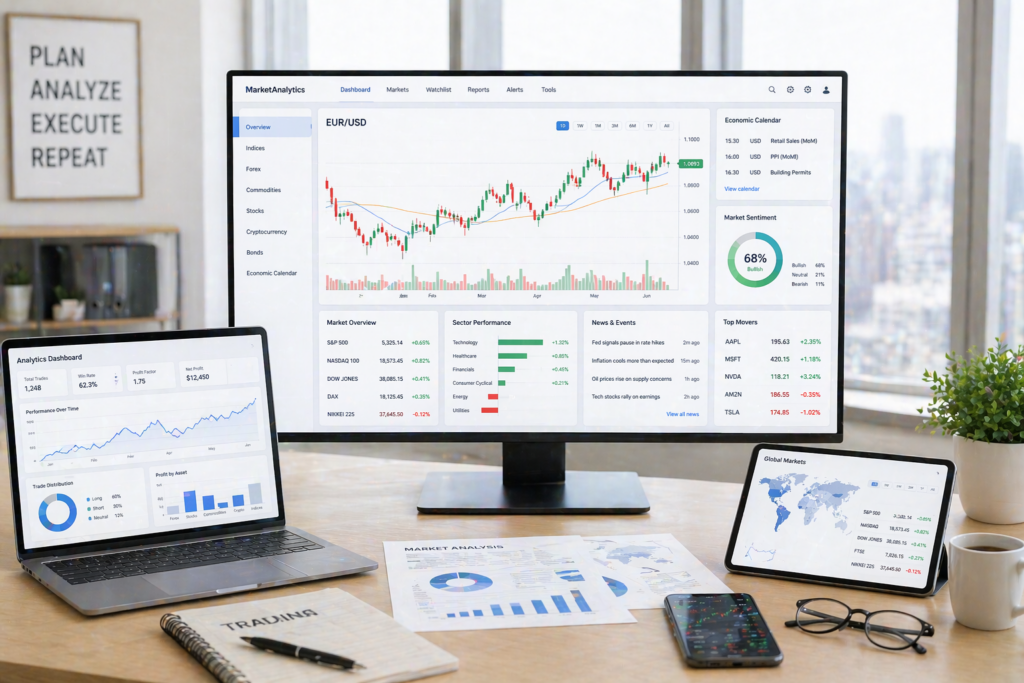
In an environment of intense competition and rapidly changing markets, analysis platforms have become an indispensable tool for traders. They provide access to a wealth of data and analysis instruments that make it possible to better understand market movements and make informed decisions. Thanks to modern technologies, traders can track market changes in real time, recognize patterns, and react quickly to new signals. Analysis platforms thus form the foundation for efficient and successful trading.
Charts and Indicators
One of the most important tools of analysis platforms are charts and technical indicators. They visualize price movements and help identify trends as well as support and resistance levels.
Indicators such as moving averages, RSI, or MACD make it possible to assess the strength of market movements and identify potential entry and exit points.
This gives traders a clear picture of the market situation and enables them to make informed decisions more quickly.
Data Analysis
Modern platforms process large amounts of data, including historical price data, trading volume, and macroeconomic indicators.
This enables deep analysis and the identification of hidden correlations.
Automated tools facilitate evaluation and support traders in making decisions based on objective data rather than intuition.
Market Monitoring
Analysis platforms offer the ability to monitor markets in real time.
Traders can observe multiple markets and assets simultaneously.
This is particularly crucial during volatile phases, as market conditions can change quickly and a swift response is required.
Forecasting Tools
Many platforms feature integrated forecasting functions based on statistical models and algorithms.
These help anticipate possible market developments and adjust strategies accordingly.
Even though forecasts provide no guarantee, they improve the quality of analysis and preparation for various scenarios.
User-Friendliness
Modern analysis platforms are characterized by intuitive user interfaces and high functionality.
Traders can customize their work environment individually and switch efficiently between different tools.
This increases productivity and reduces the likelihood of errors in the trading process.
Conclusion: Analysis platforms play a central role in modern trading by providing powerful tools for analysis and decision-making. Charts, data analysis, market monitoring, and forecasting tools help traders better understand markets and react flexibly to changes. In a complex and dynamic financial world, such platforms are no longer just helpful — they are a fundamental prerequisite for successful trading.